
#052: Meowth
That's Right

But the wildest of all the wild animals was the Cat. He walked by himself, and all places were alike to him.
Rudyard Kipling, “The Cat That Walked by Himself,” Just So Stories
If you’re a fellow English-speaking millennial, there’s a fairly high chance that reading this post’s title caused you to silently say “Meowth, that’s right!” in a Brooklyn accent. As one third of the Team Rocket trio that pursues Ash, Pikachu and their rotating cast of traveling companions over hundreds and hundreds of anime episodes, this particular Meowth — a rare Pokémon capable of speaking like a human rather than just repeating its name over and over again — is one of Pokémon’s most ubiquitous characters. According to Bulbapedia, he appears in more than 1,000 episodes, second only to Ash’s Pikachu in terms of number of appearances for a Pokémon.1
We’ve arrived, in other words, at one of the star Pokémon, and I hope to do it justice here. Unlike previous posts, however, this will not be a descent into the depths of history in search of a mythical creature’s ancient origin because Meowth’s inspiration is literally much closer to home.
Like mice, cats’ global presence and close proximity to humans leads to a wealth of cultural meaning. Meowth, its evolved form Persian,2 the Egyptian goddess Bast, Puss in Boots, Cheshire Cat, the musical Cats and its notorious film adaptation, Garfield, Grumpy Cat, LOLcat, scaredy-cat, copycat, fat cat, cat lady, cat burglar, catfight, catnap. Letting the cat out of the bag; curiosity killed the cat; playing cat and mouse; raining cats and dogs; fighting like cats and dogs; look what the cat dragged in; cat got your tongue?
Providing a comprehensive analysis of cats in human culture would be as difficult as herding cats. But there’s more than one way to skin a cat. I will focus on one specific aspect of cat symbolism that directly influenced Meowth — the originally Japanese figurines known as maneki-neko or beckoning cats — before concluding with a look at how Meowth’s behavior, personality and abilities reflect real-life cats.
I recently published a post about the Pokémon Arcanine, first generation Pokémon’s lion analogue. The lion has a fairly consistent, interconnected set of cultural meanings: it signifies royalty, power, courage and so forth, meanings inherited by Arcanine. Cats, on the other hand, embody a broader, more contradictory set of meanings. They can be lucky or unlucky, protective or threatening and, in the case of Schrödinger’s cat, simultaneously alive and dead.
If you designed a new leonine Pokémon, it would probably resemble Arcanine; Pyroar and the legendary beast Entei certainly do. A new feline Pokémon, however, can end up very different than Meowth:
Meowth’s own evolved form Persian emphasizes the elegance and fickleness of domestic cats;
Umbreon evokes the various superstitions connected to black cats;
Espeon takes after the feline yokai known as the nekomata;
Skitty and its evolution Delcatty lean into the cuteness and daintiness of domestic housecats;
Meowth, in other words, is just one possibility for a feline Pokémon, one rooted in a specifically Japanese cultural phenomenon.
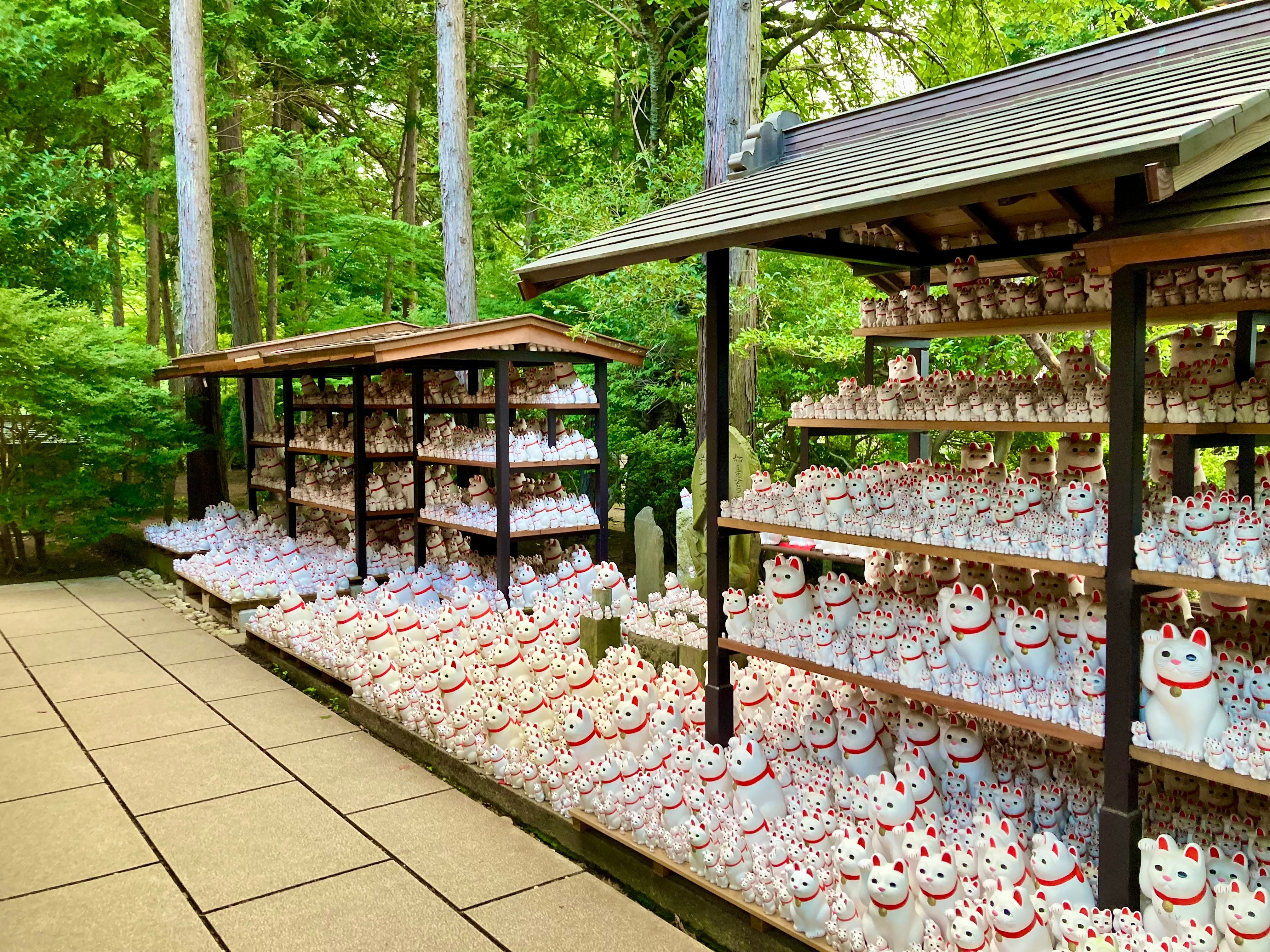

As seen above, Tokyo’s Gōtoku-ji Temple is internationally famous for the thousands of maneki-neko figurines left there as offerings. Founded in the 15th century as the family temple of the Li samurai clan, the Sōtō Zen Buddhist temple was rebuilt in 1633, an event that has itself become legendary.
“One day,” to quote the temple’s website,
a lord on his way back from falconry was beckoned by a cat at the temple gate and decided to stop by.
While spending time at the temple, thunder suddenly rang out and rain began to fall. Having gotten well out of a thundershower with an enjoyable conversation with the temple master, the lord was impressed by this luck that the cat brought.
The lord was Naotaka Li, the lord of Hikone domain.
Financially backed up by Naotaka, Gotokuji temple was rebuilt in 1633.
To commemorate this event, visitors to the temple leave maneki-neko figures as offerings, a practice featured in the Chris Marker film Sans Soleil (1983) and countless Instagram posts. If you read any article about maneki-neko, you’ll probably read some variation on this story.
While the Gōtoku-ji temple is the most famous feline temple in Japan, it is not the only one. A small 11th century Shinto shrine known as Imado Jinja (in Akasuka, Taitō City, Tokyo) also claims to be the birthplace of maneki-neko. According to its origin story, a poor old woman could no longer afford to feed her pet cat; it appeared to her in a dream and told her to make dolls in its image. She did so, using local Imado clay, and began selling them at the shrine, earning enough to feed her cat and starting a tradition that continues to this day.
Dream-cats aside, Imado does seem like the most plausible birthplace of maneki-neko. For centuries, Imado potters have made various ceramics (known as Imado ware) out of local clay. About three hundred years ago, they started making painted ceramic dolls, a tradition that likely evolved into the production of maneki-neko.
Interestingly, and perhaps not coincidentally, both versions of the Imado maneki-neko legend I read specifically date the story’s events to 1852, the exact same year in which Utagawa Hiroshige created the very first extant artistic representation of maneki-neko. That seems to be the moment when maneki-neko first hit the Japanese mainstream.
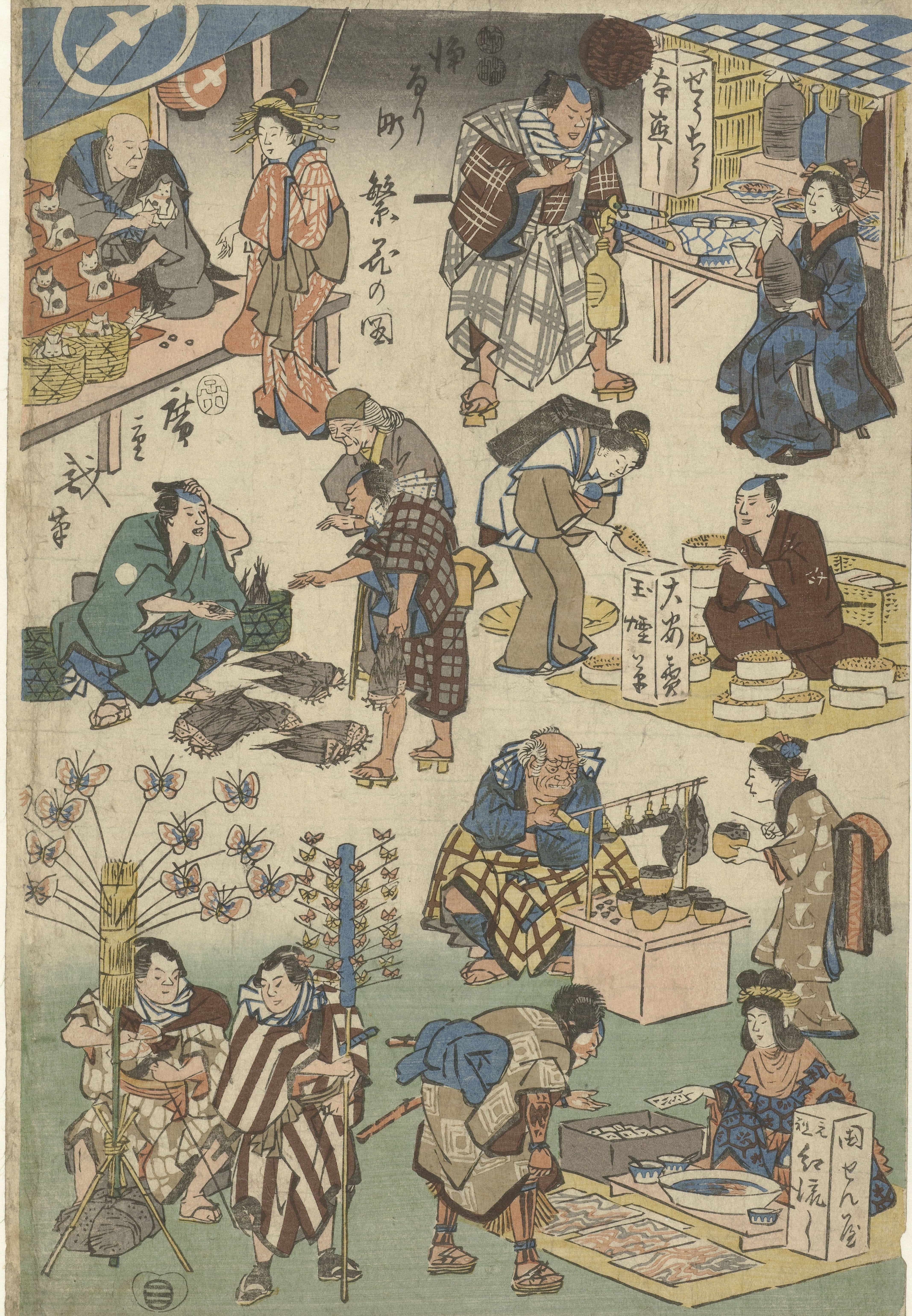
In the upper left-hand corner of Hiroshige’s print, a vendor sells black and white proto-maneki-neko from under a blue awning. Like their modern descendants, Hiroshige’s cats make a beckoning hand gesture that non-Japanese audiences sometimes identify as waving goodbye; it actually has the opposite meaning.
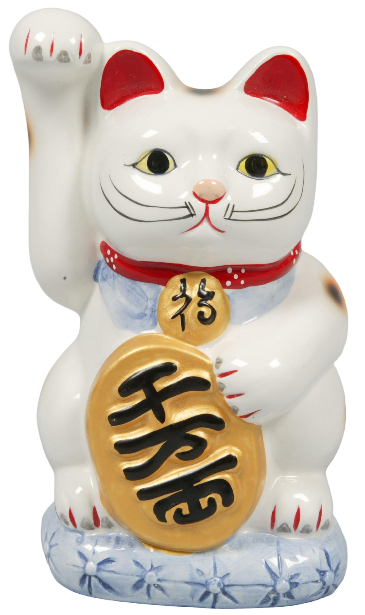
Hiroshige’s cats do lack one key aspect of the modern maneki-neko, the gold: generally a golden bell and a stylized representation of a traditional Japanese koban coin, but sometimes just one or the other. Combined, the beckoning gesture and coin add up to a creature that attracts luck and wealth, an appealing symbol in the maneki-neko’s original context and our own.
If you look beyond the maneki-neko stall to the rest of Hiroshige’s woodblock print, you see a bustling street market, one manifestation of the floating world of urban leisure and commerce that Hiroshige and other artists depicted in their ukiyo-e prints. In other words, modernity which would soon accelerate with the 1868 Meiji Restoration and rapid westernization and industrialization during the Meiji era; Nintendo (founded in 1889 as a playing card company) is itself a product of this economic boom.
Contemporary Japan, as I discussed in a previous post, has a culture of yuru-kyara: cartoonish, often kawaii characters that serve as mascots for cities, towns and corporations. Maneki-neko seem like an early prototype of these characters. What better mascot for business owners in a country focused on economic growth than a cute, lucky welcoming cat that signifies prosperity?

While researching this post, I came upon a 1998 Japan Quarterly article by Lawrence K. Hong titled “Japanese Pop Culture on the New Silk Road.”3 In it, he describes the interaction between Japanese and Chinese American culture in a San Gabriel Valley shopping center in words that bring me back to my younger years in Irvine, California, a city known for its Asian American communities.
The signs in the display windows tell it all: “New Arrivals from Japan,” “Japan CD and Gifts,” “Japanese Import,” “Lingerie from Japan.” There, one may find Japanese brand names from Kojiro nail-clippers to Takumi Magnetic Eyewear. Teenagers hang around the Neo Print machine to have their photo stickers made, and others, at the toy shop, gaze covetously at Bandai’s Sailor Moon or Hasegawa hobby kits, while their mothers and older sisters try out the latest hues at Shiseido.
If you add my brother and I also gazing covetously at packs of Pokémon cards and bootleg Dragon Ball Z action figures at 99 Ranch Market, you have a glimpse into my own childhood.
“The first telltale sign of Japanese cultural infusion in the San Gabriel Valley,” Hong continues, is the maneki-neko. He argues that, for second-generation American-born Chinese and more recent immigrants from Hong Kong and Taiwan, the maneki-neko has replaced the statue or altar of the legendary hero-god Guan Di4 as a luck-bringing retail guardian.
When I was growing up, Chinese and even Thai and Vietnamese shops almost invariably had maneki-neko at the front counter; 99 Ranch Market had a mini store-within-a-store selling maneki-neko in various sizes and colors. From its Imado origins, the maneki-neko had become a global Asian icon, a status it retains in 2026.
Why? I can think of a few reasons:
Since Hello Kitty — a character possibly inspired by maneki-neko — in the seventies, the kawaii aesthetic has been a major Japanese culture export, and maneki-neko have clear kawaii appeal.
As I discussed in a previous post, many cultures throughout history have created statues to symbolically guard doorways and other spaces. Is the maneki-neko a shrunken, portable, affordable kawaii-ified contemporary version of the sphinx?
As Hong notes, Chinese, Taiwanese and Hong Kong American communities already had traditions of placing threshold guardians like Guan Di at business entrances; maneki-neko provided an appealing modern, secular alternative.
Real cats have long inhabited human spaces, serving as both rodent control and, in some cases, mascots: library cats, Bodega cats, cathedral cats, the United Kingdom’s Chief Mouser to the Cabinet Office. Maneki-neko symbolize this connection without the need to care for a real animal.
“It is too soon,” Lawrence K. Hong concludes, “to suggest that infatuation with things Japanese could spread beyond the New Silk Road,” his term for the San Gabriel Valley’s Chinese American community. His article came out in the April-June 1998 issue of the Japan Quarterly. A few months later, in early September, a show called Pokémon premiered on American television, beginning one of the United States’ biggest and longest lasting infatuations with things Japanese. And Meowth — Pokémon’s version of the maneki-neko — was a big part of it.
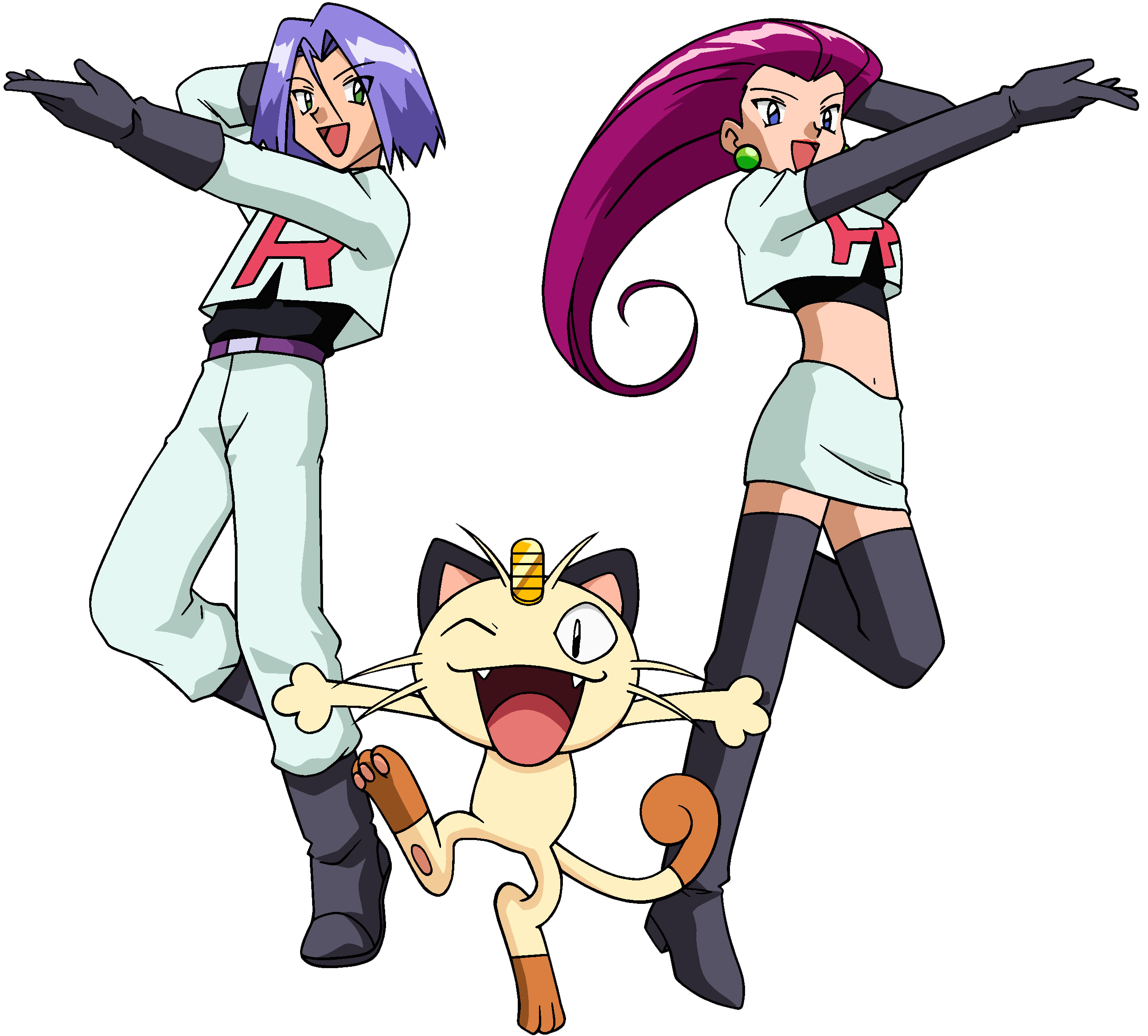

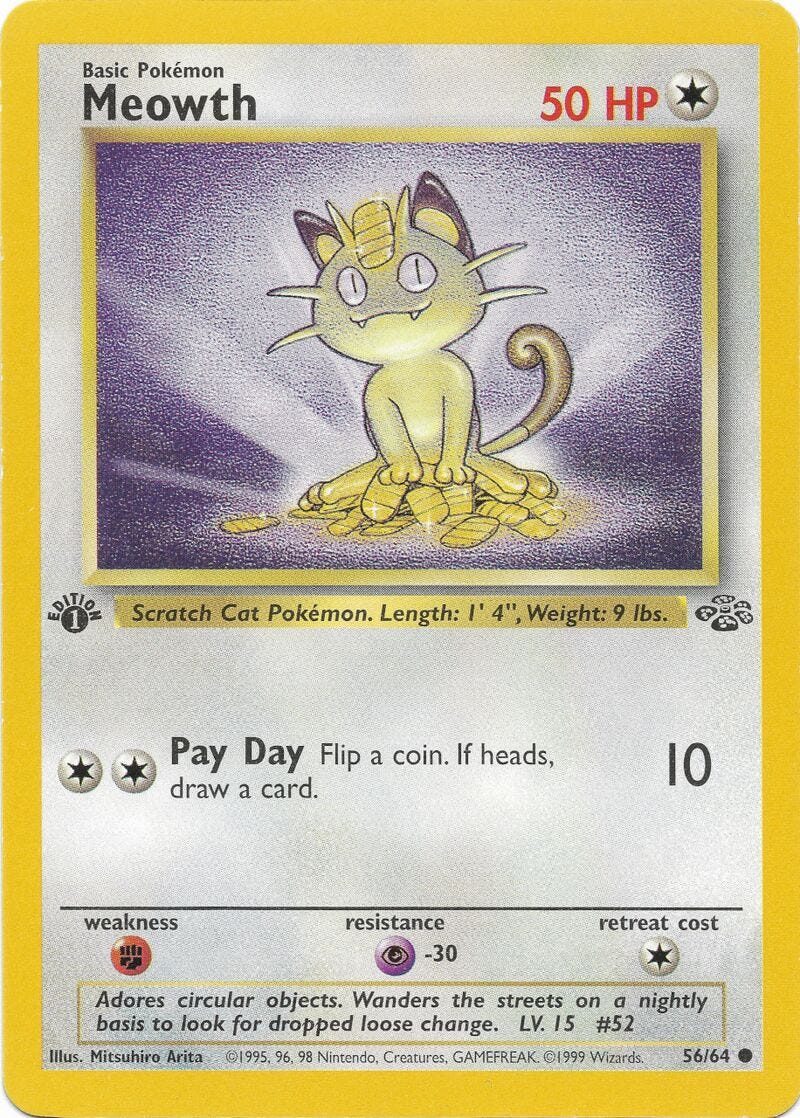
Visually, Meowth clearly resembles the maneki-neko; it is a white cat with the maneki neko’s signature koban coin in its forehead.5 Pokémon Trading Card Game illustrators emphasize this connection by depicting Meowth making the beckoning hand gesture.
Like the maneki neko, Meowth brings wealth. Its unique signature attack is Pay Day, which both damages the opponent and adds money to the player’s inventory.6 All three of its first generation Pokédex entries echo this theme. Meowth “adores circular objects,” according to the Red and Blue Pokédex; it “wanders the streets on a nightly basis to look for dropped loose change.” Yellow describes its love for “round and shiny things,” while Pokémon Stadium has it sleeping during the day and collecting coins at night.
Like its adversary Pikachu, Meowth is a minor Pokémon in the original Game Boy games who became a star on television. Game Meowth is a Pokémon Blue exclusive that can be caught in the wild on the routes around Saffron City and doesn’t play a major role in the plot. As a pure Normal-type with fairly low stats, it’s not a particularly useful Pokémon in combat and is thus not used by most players.
I have to think that the anime writers and producers chose Meowth as the series’ reoccurring villain Pokémon to match Pikachu as the hero. Cat and mouse, an elemental conflict that crosses all culture boundaries and echoes classic cartoon conflicts like Mickey vs. Pete or Jerry vs. Tom. Because Meowth talks, he has a much stronger, more forceful personality than Pikachu, one that manifests itself in very feline ways.
I began this post with a quote from Rudyard Kipling’s “The Cat that Walked by Himself,” one of the Just So Stories for Little Children (1902). Kipling’s fable takes place in a mythical past and follows an archetypical Adam and Eve-like couple — called simply the Man and the Woman — as they tame wild animals. The dog, horse and cow agree to serve mankind in exchange for food, but the cat refuses again and again, insisting that he is “the cat who walks by himself, and all places are alike to me.” But the Man and Woman eventually outsmart the cat and make a deal with him, one that leaves him a liminal creature with one paw in the domestic human world and another in wild nature. “The cat keeps his side of the bargain,” Kipling’s narrator concludes.
He will kill mice and he will be kind to Babies when he is in the house, just as long as they do not pull his tail too hard. But when he has done that, and between times, and when the moon gets up and night comes, he is the Cat that walks by himself, and all places are alike to him. Then he goes out to the Wet Wild Woods or up the Wet Wild Trees or on the Wet Wild Roofs, waving his wild tail and walking by his wild lone.
Meowth is Pokémon’s version of the maneki-neko, but he also serves as Pokémon’s Cat Who Walks by Himself.
Like Kipling’s cat, the anime’s Meowth is a liminal figure, in his case on the border between Pokémon and trainer. He doesn’t behave like other Pokémon. He walks on two legs, not on all fours like normal Meowth. He speaks human language, rather than repeating its name. He doesn’t stay inside a Pokéball, only coming out when his trainer uses it in a battle. In battle, he doesn’t always use normal Pokémon attacks; it defeats Brock’s Onyx, which is vulnerable to water-type attacks, by pouring a bucket of water on it.7
Instead of being Jesse and James’s pet Pokémon and obeying their commands, Meowth is an equal partner who considers himself the smart one of the trio. He imagines elaborate schemes to capture Ash’s Pikachu, indulges in fantastical daydreams about impressing Team Rocket boss Giovanni, and endlessly criticizes Jesse and James for their endless incompetence. He has a softer side — reflecting wistfully on his younger years, instantly bonding with the baby Togepi — and shows loyalty to his companions but is generally, in the words of his Bulbapedia article, ambitious, conniving, jealous and “motivated by self-interest and greed.” Like the Cat Who Walked by Himself, he is a somewhat wild, untamed Pokémon who has made a bargain with humans.
Cats, the inimitable P.G. Wodehouse once wrote,
have never completely gotten over the snootiness caused by the fact that in ancient Egypt they were worshipped as gods. This makes them too prone to set themselves up as critics and censors of the frail and erring human beings whose lot they share.8
Does any fictional cat better embody this passage — the cat’s essential cattiness — than the anime Meowth?
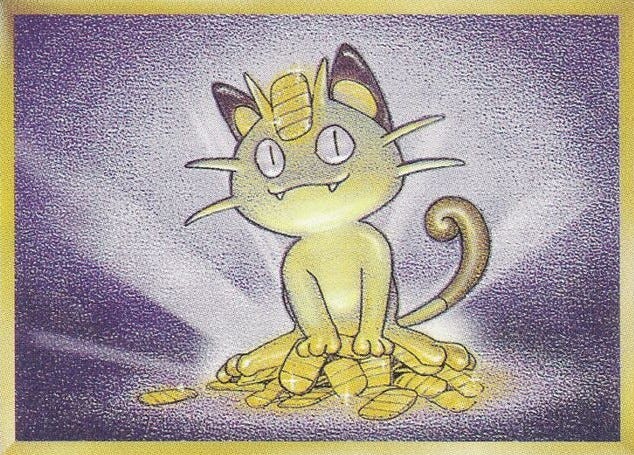
While the animated Team Rocket Meowth is undoubtedly the definitive member of his species, my mind keeps returning to this Meowth and his card’s flavor text about him walking by himself through the empty streets at night in search of coins. It’s a nocturnal, moody, almost melancholy mental image that epitomizes Pokémon’s ability to evoke a lot in a small space.
Meowth’s original English-language voice actor was Matthew Sussman (also known as Nathan Price), who played the character for about thirty episodes. He was succeeded by the late Maddie Blaustein, who voiced Meowth and various supporting characters in over 400 episodes, and then the late James Carter Cathcart (also known as Jimmy Zoppi) who passed away this past July.
Persian is presumably named after Persian cats and is best known as the signature Pokémon of Team Rocket boss Giovanni. Pokémon’s supervillain petting a white Persian cat seems like an homage to James Bond’s nemesis Ernst Stavro Blofeld.
Hong, Lawrence K. “Japanese pop culture on the new silk road.” Japan Quarterly, vol. 45, no. 2, 1998, pp. 54-60.
Also known as Guan Yu or Yunchan. A real 3rd century historical figure who became a legendary hero, a protagonist of the classic novel Romance of the Three Kingdoms, and a god still worshipped today in Taoism and Chinese folk religion.
When Meowth evolves into Persian, this coin evolves into a jewel.
This move’s original Japanese name is neko ni koban (猫に小判), “gold coins to cats,” which has a similar meaning to “pearls before swine.”
In Episode 50, “Who Gets to Keep Togepi?”
From the short story “The Story of Webster” (1932), part of the collection Mulliner Nights (1933).
Very rich analysis
Another great post. I'd never thought of Umbreon and Espeon as cats and you've caused me to see them in a new light.
I used to live very close to Gotokuji and would frequently go there to see the cats. It's gotten so popular in the last couple of years. At least I have my manekineko at home...